Here’s what I like about this dish: you’re actually making two dishes, two of my favorite ways to enjoy squid ink, then combining them. I haven’t wrapped my head around it entirely, but it seems to me that you’re essentially making the Spanish tapa Calamares en su tinta side by side with a standard risotto, then combining them half way through. I have to ponder more thoroughly whether or not this could be simplified, but for the time being, it’s a tried and true way to cook squid, combined with a tried and true way to cook risotto, and it may just be the best possible preparation for this delectably seductive dish. I’ve made squid ink risotto before just by adding the ink to the pot at the start of the cooking. Certainly it can be made this way, but perhaps the stock that you create with Calamares en su tinta is enhanced by cooking longer than the rice demands. Dunno. Either way, Calamares en su tinta is one of the most delightful ways to eat squid, and usually served with a dollop of buttery white rice in the middle – this technique twists that approach by letting the rice absorb all of the cooking liquid and giving the whole thing a deep, lustrous black sheen.
I’ve always felt like risotto was a needlessly complicated way to cook rice, with limited payoff. I’m a huge fan of pilafs and other preparations where meats and aromatics are cooked in one pot with rice and seasoned stock or broth. Risotto operates along those same lines but (to me) never feels elevated to a level commensurate with the added complications of preparation. In fact, the principal added value, derived from adding hot stock in small portions and constant stirring, is creaminess. This creaminess does not equal richness, although Italians being Italian, most preparations also call for finishing the risotto with heavy cream, and if no fish is involved, parmiggiano – two things I normally have no problem with, unless they feel like cheating, which in the case of risotto they sometimes do. The creaminess without cream comes from the starch, which, released from the rice by the constant agitation of the cook’s spoon, is a mildly ingenious innovation. This is why risotto is sometimes referred to as rice that creates its own sauce. It’s cool, but when held up against the center-stage rice dishes of the West Indies, the Caribbean, Central and South America, Central Asia, the Middle East, Africa, South Asia, and my God, East Asia – does it really distinguish itself in a class far above? There are many, many, many, many things the Italians do better than everybody else but for my money, rice is not one of them. Incidentally, I think their pastries also lag far behind, say, the French, and obviously their commitment to Fascism did not measure up to that of the Germans, Spanish, and Japanese. But back to the complications of risotto: while a standard preparation involves two pots rather than one – one for the rice dish you are building and one to hold the hot stock – this preparation ups the ante by adding a third pot in which to cook the squid in its ink. So the third pot makes clean up more onerous; add in the drips, spills, and splatter of squid ink, ma don’.
I’ve made a version of calamares en su tinta a few times before with great success, but didn’t bother to jot down how I did it, so I don’t remember the exactly preparation. It was mostly about braising the squid in wine and its ink, simmering covered for about 40 mins. This is roughly the same, with the addition of tomatoes, which I think are mostly there to add some umami and make the liquid a little fuller, and will do if you just want to make that dish with some long grain rice on the side. But the squid braising liquid isn’t enough on its own to fully cook the risotto, so you’ll also need shrimp stock for this as well. There aren’t enough shrimp shells in the preparation to make a stock especially for this, so you’ve got to have some on hand. Failing that, clam juice, lobster stock, or fish stock will do. Obviously homemade is best. As you know well by now, I save shrimp shells in the freezer – this recipe is a good excuse to make shrimp stock from the shells that have been collecting there, or vice versa: if I need to get rid of the shells and make a stock, this is a great thing to do with it.
Finally, squid ink: If you buy whole squid, you have to deal with the ink sacs yourself. I’m not experienced enough with this to tell you what to do, but you can figure it out by using the world wide webs. Otherwise, buy squid that seems reputable from a fishmonger who is beyond reproach.
Ingredients:
- 12 oz calamari, bodies and tentacles, cleaned
- 8 oz shrimp, peeled and deveined
- 4 cloves garlic, minced
- 1/2 cup (usually 2 medium) finely chopped shallot
- 3 TBS olive oil
- 1 cup finely chopped tomatoes (I use Pomi but fresh is also fine)
- 1 oz butter
- 1/2 cup dry white wine
- 1 TBS red pepper flakes
- 4 cups shrimp stock (you probably won’t use it all)
- 1 cup Arborio rice or if you want the super creamy, go with Carnaroli (You can go up to 1.5 cups if you’re serving more people or down to 3/4 cup if necessary without adjusting the quantities of anything else. You’ll use more stock, but you have enough on hand. I think 3/4 of a cup of dry rice comfortably serves 2 people if they don’t want 2nds and they’re not risotto monsters.)
- 1 tsp squid/cuttlefish ink
- 1/2 cup minced fresh parsley
- squirt of fresh lemon juice
- salt and pepper
Directions:
Begin by chopping your shallot and garlic and setting aside in two separate bowls (half your shallot is for the calamari and half is for the risotto, and the garlic is added separately). Heat your stock to just simmering, then lower the heat to the absolute minimum, and keep on the back burner. I like to put it on a diffuser on the lowest possible heat of the smallest back burner – this keeps it steaming constantly, but not really simmering. This allows it to stay at it’s hottest while reducing the least. The burner that you put it on should be directly behind the one you’re going to make the risotto on.
While the stock is coming up, clean the squid. Place everything in a colander and run under cold water. I start by picking up the tentacles and holding each one under running water, then putting them in a bowl. You want to clean these because, in addition to any cross-contamination of who-knows-what that they may have picked up in their journey from the sea to your kitchen, the squid’s tentacles are covered in tiny little suckers which are hard and inedible and should have been removed, but you want to wash away any little pieces that may be clinging to it. You also want to make sure that each squid’s pen, which is the plastic-like cartilage that forms its inner shell, and its beak – collectively, the only hard parts of the squid’s body – have been completely removed from this dish and discarded. Once the tentacles are done, take each body individually and run water inside and out, thoroughly rinsing them. Once everything is rinsed, drain everything again through the colander or fine mesh strainer. It doesn’t need to be totally dry. Slice the calamari bodies into rings a little less than an inch wide. I usually get 3 or 4 rings out of each body, but how you slice this is up to you, just depends on how you want to eat it. They need to incorporate evenly into the risotto though, so you really can’t leave them whole, and I think they should be about bite sized, since this is how the tentacles will end up.
Place two TBS of the oil in a pan and heat until shimmery. Add half the shallot, salt, black pepper, and the red pepper flakes and cook over medium low heat, stirring frequently, until the shallot is completely softened but not browned. Raise the heat, add all the squid and the garlic and cook, tossing frequently, for about 30 seconds, so that everything is up to temperature and evenly coated. Add the ink, and continue to cook over high heat for one to two minutes, until the squid has curled and turned slightly more opaque. Add the wine, cooking for another minute or so and scraping the sides and bottom to deglaze where necessary, and making sure that the ink is thoroughly and even diluted and distributed. Add the tomatoes, a little more salt and pepper, and bring to a low simmer. Cover and cook for 30 minutes and a constant low simmer, stirring every 5 mins or so. If it’s cooking too fast or the lid isn’t secure or the squid doesn’t release the water you expect, it may dry out a bit – add small amounts of stock to keep it saucy. This probably won’t happen though.
This is a good time to peel, devein, and rinse your shrimp, since once the risotto starts, you won’t have a chance to do anything but stir. Once they’re prepped, set them aside. You should also mince your parsley now.
After the calamare en su tinta has been cooking for about 20 minutes, begin the risotto. Start by adding the remaining TBS of olive oil and the butter to a pot. I like to use an 8-qt pot for this, but there’s a variety that will be successful. You want the rice to have a lot of surface area on top, so stirring it is more about moving it around the bottom of the pot, rather than from the bottom to the top – so something that’s small and tall will be less successful – but too much surface area and the liquid will evaporate before it absorbs, so a saute pan isn’t the right choice either.
When the oil/butter mixture is hot, add the remaining shallot, salt, and pepper, and cook on medium low heat until it is soft but not browned. Raise the heat to medium high and add the rice, and stir so it is throughly coated. Toast the rice for about a minute – until the “pearl” appears in each grain. I don’t know much about the lore of this, but essentially this means that the ends and surface of each grain of rice turn translucent and the only part that remains white and opaque is directly in the center of every grain, like a pearl. Italians insist that you must toast the rice to this stage before adding any liquid.
Add some stock. Depending on how much rice you’ve got, this should be about a 1/2 cup to a cup at a time. My ladle is just about a half cup, and a ladle plus a little bit is usually good for a cup of dry rice. You want to add enough stock to barely cover the rice. Begin stirring immediately and keep stirring – the level of liquid should be barely saucy. Almost immediately, it will thicken slightly and you will begin to see the bottom of the pot where your spoon drags across it. When it seems like the liquid is almost entirely absorbed, add another ladle or so and keep stirring. When that ladle has been absorbed, the calamari is probably just about perfect – add everything in that pot to the risotto pot. If you have a little less rice, you can add this after the first ladle; a little more, add it after a few more ladles – but it has to happen pretty early in the process. After all the calamari liquid has been absorbed, you’re just going to add enough stock to finish it – but you don’t want the rice to get too cooked and then add the calamari liquid, only to find out that it’s too much.
Stir, stir, stir. Keep stirring constantly, evenly, and slowly until the black liquid has been almost completely absorbed. Taste the rice. It should still be a bit chalky in the middle. Keep adding stock, one or so ladleful at a time, until the rice is done. I taste frequently at this point, adjusting seasonings where necessary, and making sure the rice is perfectly al dente. At that magic moment where it seems like it is 98% done, I take a smaller spoon, and give the whole thing a vigorous stirring, almost like whipping it. This seems to almost emulsify things – the volume seems to swell and it becomes a little lighter, airier.
Add the shrimp and half the parsley, stirring to combine. The shrimp will spring a little liquid, which is good, so cook until they’re done and the liquid has been absorbed. A lot of this is about judging consistency – you want the whole thing to be almost soupy – not thin and drippy, but it shouldn’t be sticky or dry either.
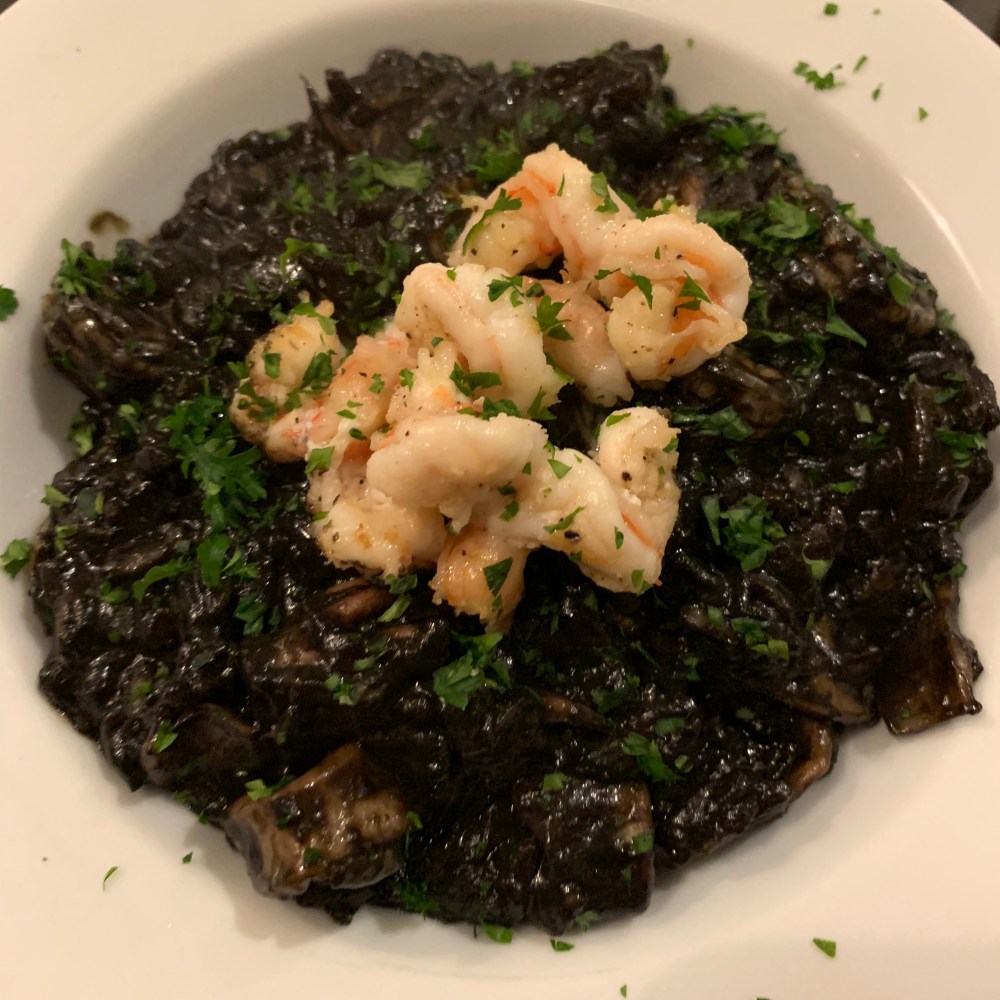
Because the ink is so visually overpowering, the squid and shrimp will be lost in the mix. Therefore, for presentation’s sake, it’s nice to butterfly a few of the shrimp and saute them separately, maybe in a little garlic and olive oil, and place on top. The red of the shrimp really pops against the deep shiny black of the rice. The rice is loaded with delicious morsels, but it will be hard to see them. Same with the parsley – from a strictly visual point of view, this dish is a bottomless well of deep seductive black, so sprinkling the remaining parsley over the top without mixing it in gives it a little something it needs. I don’t do either of these things when I’m eating alone, I just mix it all in, but it’s a good idea to garnish it this way if you’re serving to others.
Whether alone or in good company, serve immediately and enjoy.
cazzo figa tetta culo pompino! che palle risotto!
 The Grumpy Gastronome
Leave a comment